
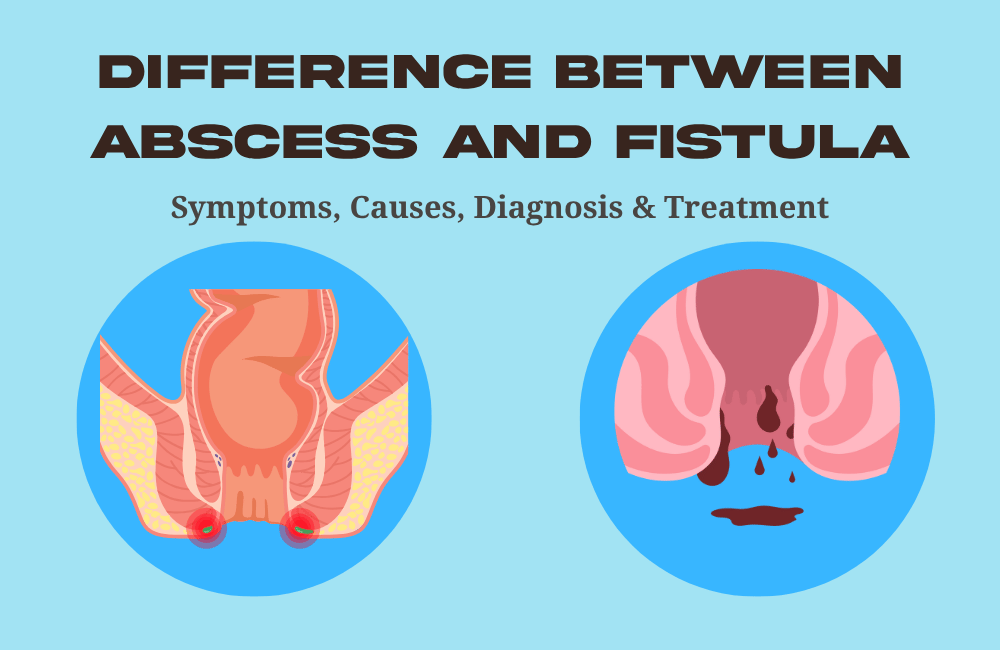
Pain, swelling near the anus, pus discharge, or repeated infections can cause significant discomfort and anxiety. Many patients experiencing these symptoms often wonder whether they are dealing with an anal abscess or a fistula.
Although both conditions originate from infection around the anal glands and are closely related, they represent different stages of disease progression. Understanding the difference between abscess and fistula is essential because their symptoms, treatment methods, and long-term management differ significantly.
An anal abscess is an acute infection that causes a collection of pus near the anus, while an anal fistula is a chronic abnormal tunnel that forms between the anal canal and the skin. In many cases, a fistula develops after an untreated or inadequately healed abscess.
This comprehensive guide explains the difference between anal abscess and fistula, including symptoms, causes, diagnosis, treatment options, and when to seek medical care.
Understanding Anal Gland Infections
Inside the anal canal are small mucus-secreting glands known as anal glands, located in the intersphincteric space between the internal and external anal sphincter muscles. These glands help lubricate the anal canal during bowel movements.
However, when these glands become blocked or obstructed, bacteria normally present in the intestine can multiply inside them. This bacterial growth leads to infection and the formation of pus.
The infection process usually progresses through several stages:
- Anal gland obstruction occurs due to debris or inflammation
- Bacteria multiply inside the gland, causing localized infection
- Pus accumulates, leading to the formation of an anal abscess
- If the abscess drains but the infected tract does not heal properly, an abnormal tunnel forms
- This persistent tunnel becomes an anal fistula
Because of this mechanism, most fistulas develop secondary to a previously existing abscess. This explains why both conditions are often discussed together in colorectal disease.
What Is an Anal Abscess?
An anal abscess (also called perianal abscess) is a localized infection that leads to a collection of pus in the tissue surrounding the anus or rectum.
It is considered an acute surgical condition because it causes severe pain and often requires immediate drainage.
Common Characteristics of Anal Abscess
Patients with an abscess typically experience:
- Sudden severe pain near the anus
- Swelling and redness
- Fever and fatigue in some cases
- Pain during bowel movements
- Difficulty sitting or walking
- Tender lump near the anus
The infection causes pus accumulation, leading to pressure and intense discomfort.
Types of Anal Abscess
Depending on the location of the infection, abscesses can be classified into different types.
Perianal Abscess – The most common type, located near the anal opening.
Ischiorectal Abscess – Occurs deeper in the buttock tissue and may cause severe swelling.
Intersphincteric Abscess – Forms between the internal and external anal sphincter muscles.
Supralevator Abscess – A rare but deeper abscess located above the levator muscles.
The severity and treatment approach depend on the abscess location.
What Is an Anal Fistula?
An anal fistula, also known as fistula-in-ano, is an abnormal tunnel connecting the infected anal gland to the outer skin near the anus.
This tunnel develops when the infection from an abscess fails to heal completely.
Instead of closing, the tract remains open and continues to drain.
Common Symptoms of Anal Fistula
Patients with fistula often report:
- Persistent pus discharge
- Recurrent swelling near the anus
- Foul smell or staining of underwear
- Mild pain during bowel movements
- Skin irritation around the anal area
Unlike abscess, the pain is usually less severe but more persistent.
Types of Anal Fistula
Fistulas are categorized based on their relationship with anal sphincter muscles.
Intersphincteric Fistula – Most common type, located between sphincter muscles.
Transsphincteric Fistula – Passes through the external sphincter muscle.
Suprasphincteric Fistula – Extends above the sphincter muscle.
Extrasphincteric Fistula – Rare and complex, extending outside the sphincter system.
The complexity of the fistula determines the treatment strategy.
Key Difference Between Abscess and Fistula
| Feature | Anal Abscess | Anal Fistula |
|---|---|---|
| Nature | Acute infection | Chronic abnormal tunnel |
| Cause | Bacterial infection | Usually develops after abscess |
| Pain | Severe and sudden | Mild or recurrent |
| Pus | Collected inside tissue | Continuous discharge |
| Fever | Common | Rare |
| Treatment | Surgical drainage | Surgery required |
| Recurrence | May lead to fistula | Chronic condition |
This comparison clearly highlights the difference between abscess and fistula.
How Abscess Leads to Fistula
The progression from abscess to fistula is well documented in colorectal disease.
The process occurs as follows:
- Infection begins in an anal gland
- Pus accumulates, forming an abscess
- The abscess either ruptures naturally or is surgically drained
- If the infection persists, a tract forms between the gland and the skin
- This tract becomes a chronic fistula
Studies indicate that approximately 30–50% of anal abscesses eventually develop into fistulas.
Prompt drainage and proper treatment significantly reduce the risk of fistula formation.
Diagnosis of Abscess and Fistula
Accurate diagnosis is essential for choosing the correct treatment.
Doctors may use several methods:
Physical Examination
Doctors examine the anal region for swelling, redness, or discharge.
Digital Rectal Examination
A gloved finger is used to feel for internal swelling or tenderness.
Proctoscopy
A small instrument allows visualization of the anal canal.
MRI Fistulogram
MRI is considered the gold standard imaging technique for detecting complex fistula tracts.
It helps identify:
- Internal openings
• Branching fistula tracts
• Abscess pockets
Endoanal Ultrasound
This imaging technique helps detect infections in deeper tissues.
Complications if Abscess or Fistula Is Left Untreated
Ignoring symptoms of an anal abscess or anal fistula can lead to serious complications because the underlying infection may continue spreading to nearby tissues. What begins as a small swelling or occasional discharge can gradually develop into a more complex and painful condition.
Possible complications include:
- Recurrent infections due to persistent bacterial growth
- Formation of multiple fistula tracts, making treatment more complex
- Spread of infection to deeper surrounding tissues
- Chronic pain, swelling, and discomfort during daily activities
- Sepsis in rare cases, if the infection enters the bloodstream
- Reduced quality of life due to ongoing pain and drainage
Early diagnosis and proper treatment help prevent these complications and improve recovery outcomes.
When Should You See a Doctor?
Consult a doctor if you experience:
- Severe or persistent anal pain
- Swelling or a painful lump near the anus
- Fever or signs of infection
- Persistent pus discharge
- Repeated abscess formation
Early medical evaluation helps confirm the diagnosis and prevents the condition from progressing into a chronic anal fistula.
Prevention Tips
Although not all cases can be prevented, certain habits may reduce the risk of anal abscess and fistula.
Helpful preventive steps include:
- Maintaining good anal hygiene
- Preventing constipation with a high-fiber die
- Drinking adequate water daily
- Treating abscess infections early
- Managing underlying conditions such as diabetes
Adopting healthy bowel habits and seeking timely treatment can significantly reduce the risk of complications.
FAQs
An anal abscess is a pus-filled infection that forms in the tissues around the anus due to bacterial infection. An anal fistula is a small abnormal tunnel that develops between the anal canal and the skin near the anus, usually after an abscess fails to heal completely.
No. Not every abscess develops into a fistula. However, studies suggest that 30–50% of anal abscess cases may progress to a fistula if the infection does not heal properly or the drainage tract remains open.
An anal abscess is more painful and requires urgent drainage because it is an active infection. A fistula, on the other hand, is a chronic condition that may cause recurring discharge and typically requires surgical treatment for permanent healing.
Antibiotics alone usually cannot cure an anal abscess because the infection contains pus that must be drained. Surgical drainage is the standard treatment, while antibiotics may be prescribed in certain cases.
In most cases, an anal fistula does not heal on its own. Because the abnormal tract remains open, surgical treatment such as fistulotomy, laser treatment, or other procedures is usually required for permanent healing.
Final Thoughts
The difference between abscess and fistula lies in their nature and progression. An abscess represents an acute infection requiring urgent drainage, while a fistula is a chronic abnormal tract that develops when infection fails to heal completely.
Recognizing symptoms early and seeking timely treatment prevents complications and improves long-term outcomes.
If you experience persistent pain, swelling, or discharge near the anus, consult a specialist for accurate diagnosis and appropriate treatment.