
Advanced Laser Fissure Care
Fissure Treatment in Bangalore
Sharp, burning pain during or after passing stools is often dismissed as a temporary problem. If it’s accompanied by bleeding, it could be an anal fissure — a small tear in the anal canal that can be treated with advanced laser fissure treatment in Bangalore, offering a daycare procedure with minimal discomfort and faster recovery.
Led by Dr. Varun Kumar J, a General, Laparoscopic and Laser Surgeon, our team provides personalised treatment plans based on the severity of your fissure.
18+
Surgical Experience
Day-Care
Go Home Same Day
4.9★
Google Rating
20–40 Min
Laser Procedure Duration
Why Laser
Benefits of Laser Fissure Treatment
🩹
Minimally Invasive
Laser energy treats the fissure precisely through a tiny access point, minimising trauma to surrounding tissue.
🩸
Minimal Bleeding
The precise laser technique means the procedure typically involves very little blood loss.
✅
Smaller Wounds
Smaller surgical wounds mean less scarring, lower infection risk and faster healing.
😌
Less Post-Op Pain
Reduced tissue trauma means noticeably less discomfort during recovery compared to conventional surgery.
🏥
Day Care
Most patients are discharged the same day, with no overnight hospital admission required.
🏆
Faster Recovery
Many patients return to desk-based work within just 2–5 days after treatment.
Your Specialist
Meet the Specialist – Fissure Treatment Doctor in Bangalore

Dr. Varun Kumar J
General & Laser and Laparoscopic surgeon
- 🎓DNB – General Surgery
- 🎓FIAGES
- 🎓FMAS
18+
Yrs Overall
11
Yrs Specialist
99%
Patients Recommend
Dr. Varun Kumar J is a General, Laparoscopic and Laser Surgeon who completed his MBBS at Basaveshwara Medical College, Chitradurga, and his DNB in General Surgery at Narayana Hrudayalaya, Bangalore. He is a Fellow of the Indian Association of Gastrointestinal Endo Surgeons (FIAGES) and holds a certificate in Laser Varicose Veins Treatment. He is one of the earliest doctors in Bangalore to specialise in laser-based vein and proctology procedures, and has treated varicose veins, piles, fissure and fistula cases for patients across the city. He consults at Hari Laser Clinics along with several other reputed hospitals in Bangalore.
Understand The Condition
What Is an Anal Fissure?
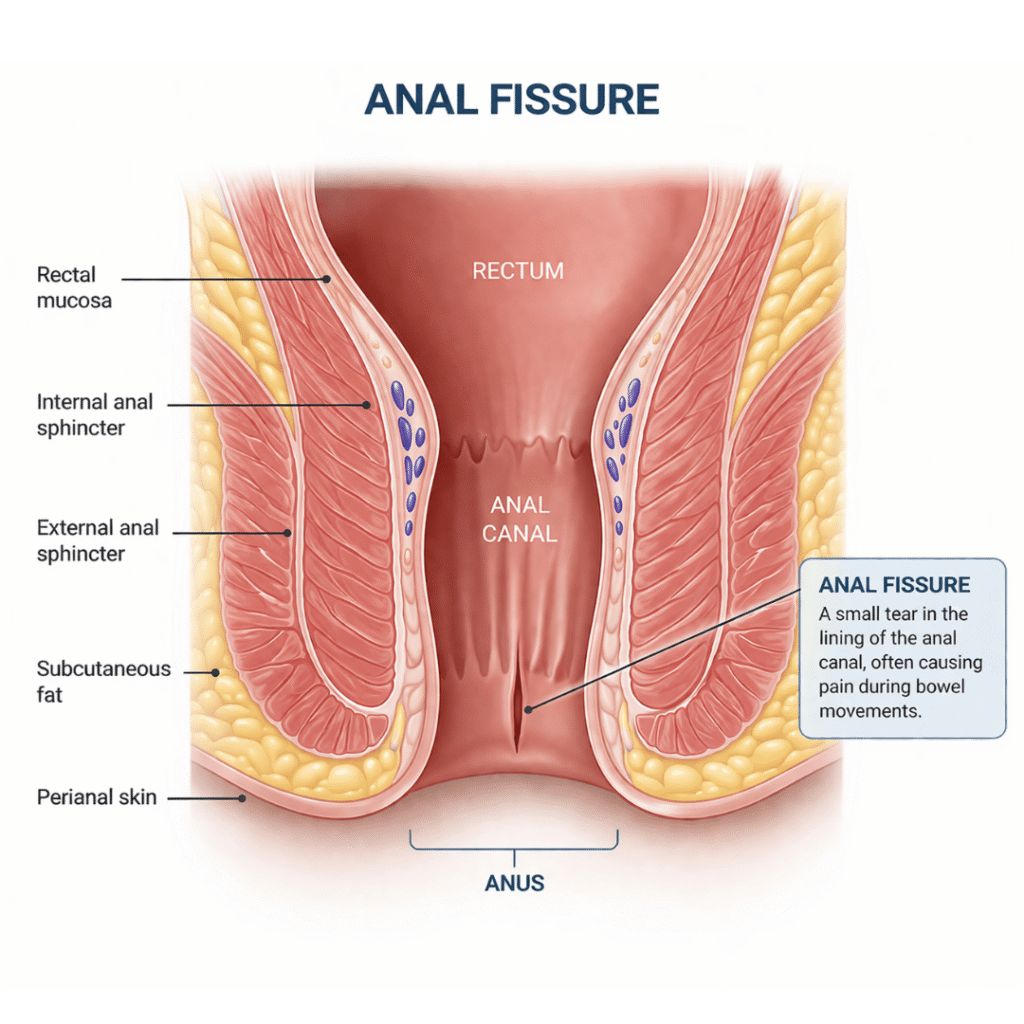
An anal fissure is a small tear or crack in the thin lining of the anal canal. Although the tear itself is usually small, it can expose the sensitive muscle beneath, causing intense pain during and after bowel movements.
Unlike piles, which are swollen veins around the anus, a fissure is a tear in the tissue, so the symptoms differ — patients typically feel a sharp, cutting pain while passing stools, followed by a burning sensation that can last minutes or even hours. Fissures commonly occur due to constipation, repeated straining, chronic diarrhea, childbirth, or any condition that stretches the anal canal excessively.
Acute vs. Chronic Anal Fissure
ACUTE FISSURE
- ●Duration: Symptoms lasting less than 6 weeks
- ●Tear: Fresh tear without scar tissue
- ●Bleeding: Mild bleeding
- ●Pain: Sharp pain during bowel movements
- ●Treatment: Responds well to conservative treatment
CHRONIC FISSURE
- ●Duration: Persists beyond 6–8 weeks
- ●Tear: Thickened edges with scar tissue
- ●Features: Exposed internal sphincter muscle
- ●Features: Sentinel pile (skin tag) may develop
- ●Treatment: Often needs laser surgery or LIS
Symptoms of an Anal Fissure
- ⚠Sharp pain during bowel movements
- ⚠Burning pain that continues after passing stools
- ⚠Bright red bleeding on toilet paper or stools
- ⚠A visible tear near the anal opening
- ⚠Itching or irritation around the anus
- ⚠Difficulty sitting comfortably
- ⚠Fear of passing stools because of pain
- ⚠Constipation due to avoiding bowel movements
- ⚠A small skin tag (sentinel pile) in chronic cases
- ⚠Muscle spasms around the anal opening
If these symptoms persist for more than two weeks despite home remedies, it’s advisable to seek medical evaluation — early consultation helps prevent the fissure from becoming chronic.
Root Causes
Common Causes of Anal Fissures
Anal fissures develop when the delicate lining of the anal canal is stretched beyond its capacity by a combination of dietary, lifestyle and physiological factors.
🚽
Chronic Constipation
Passing hard stools repeatedly is the leading cause — excessive straining tears the anal lining.
📏
Large or Hard Stools
A single episode of passing a large, hard stool can be enough to cause an acute fissure.
🌊
Chronic Diarrhea
Frequent loose stools irritate the anal canal and increase the risk of tearing.
🤰
Childbirth
Increased pressure on the pelvic floor during vaginal delivery can cause fissures in women.
💪
Sphincter Pressure
Tight anal muscles reduce blood supply to the fissure, making natural healing difficult.
🥗
Low-Fibre Diet
A diet lacking fibre often results in constipation and repeated straining.
🔬
Inflammatory Bowel Disease
Conditions such as Crohn’s disease can increase the risk of recurrent, non-healing fissures.
🛋️
Sedentary Lifestyle
Inactivity and frequently delaying bowel movements increase the risk of fissures.
Stages of an Anal Fissure
From a fresh tear to a chronic, non-healing fissure
Day 0–1
Fresh tear after passing a hard stool or straining
Pain relief, stool softeners
Week 1–2
Sharp pain, mild bleeding, fresh tear, no scar tissue
Conservative care
Week 2–4
Pain gradually reduces, tear starts closing with proper care
Diet + sitz baths
Week 4–6
Bowel movements more comfortable, bleeding less frequent
Continue high-fibre diet
6–8 Weeks
Thickened edges and scar tissue begin to form (becoming chronic)
Topical medication / Botox
Chronic
Exposed sphincter muscle, sentinel pile, persistent spasm
Laser surgery / LIS
Long-Standing
Non-healing, recurrent fissure with complications
Urgent laser surgery
How Is an Anal Fissure Diagnosed?
Accurate diagnosis is important because conditions such as piles, fistulas, abscesses and inflammatory bowel disease can produce similar symptoms.
- ✓Detailed medical history, including pain pattern, bleeding and previous episodes
- ✓Gentle physical examination of the anal region to look for a visible tear or sentinel pile
- ✓Digital rectal examination, performed carefully once acute pain has settled
- ✓Proctoscopy or anoscopy in selected patients to rule out other conditions
This step-by-step evaluation allows Dr. Varun Kumar J to confirm whether the fissure is acute or chronic and recommend the most appropriate treatment.
Point By Point
Laser Surgery vs Conventional Surgery (LIS)
How laser fissure surgery compares with conventional Lateral Internal Sphincterotomy (LIS), point by point.
- →Minimal surgical incisions compared to conventional surgery
- →Local/regional anaesthesia, avoiding the risks of general anaesthesia in most cases
- →Daycare procedure with same-day discharge
- →Significantly less post-operative pain than open surgery
- →Faster return to walking and daily activities
- →Lower risk of infection with minimal tissue trauma
- →Better cosmetic healing with reduced scarring
Caveat: Laser treatment is highly effective for most chronic fissures, but very severe or complicated cases may occasionally require LIS or a combined approach — your surgeon will advise this after examination.
Laser Fissure Surgery vs Conventional Surgery — Feature Comparison
LASER FISSURE SURGERY
- ●Surgical Incisions: Minimal
- ●Post-operative Pain: Usually less
- ●Bleeding: Minimal
- ●Hospital Stay: Daycare procedure
- ●Recovery Time: Usually a few days
- ●Return to Work: Earlier
CONVENTIONAL SURGERY (LIS)
- ●Surgical Incisions: Small surgical incision
- ●Post-operative Pain: Generally more
- ●Bleeding: Slightly higher
- ●Hospital Stay: May require short admission
- ●Recovery Time: Around 1–2 weeks
- ●Return to Work: Slightly longer
Laser treatment has become a preferred option for many suitable patients because it combines precision with faster recovery, though the final choice depends on your surgeon’s clinical assessment.
Treatment Menu
Fissure Treatment Options at Hari Laser Clinics, Bangalore
Every patient’s condition is different — Dr. Varun Kumar J selects the right approach after a detailed clinical evaluation.
1. Advanced Laser Fissure Surgery Gold Standard
How it works:
- Pre-operative evaluation and planning
- Administration of appropriate local/regional anaesthesia
- Gentle assessment of the fissure
- Laser energy is delivered with controlled precision to the affected tissue
- Sphincter spasm is relieved where indicated
| Procedure Time | 20–40 minutes |
| Anaesthesia | Local / Regional |
| Hospital Stay | Day-care — same day discharge |
| Return to Work | 2–5 days |
| Success Rate | High, patient-specific |
| Scars | None to minimal |
2. Lateral Internal Sphincterotomy (LIS)
LIS is a standard surgical treatment for chronic fissures. A small portion of the internal anal sphincter muscle is carefully divided to reduce spasm and improve blood flow, helping the tear heal more effectively. It may be recommended for long-standing fissures, severe spasm, or when medical treatment hasn’t helped.
3. Botox Injection
For selected patients who don’t respond to medications, Botulinum toxin (Botox) injections temporarily relax the anal sphincter muscle, reducing pressure around the fissure and allowing it to heal naturally. Results may not always be permanent, and some patients may eventually require surgery.
4. Topical Medications
Prescription ointments relax the internal anal sphincter, improve blood circulation, reduce pain and promote faster healing in acute fissures. Since not every medicine suits every patient, these should always be used under medical supervision.
5. Conservative (Non-Surgical) Care
Most acute fissures heal without surgery when treated early — with a high-fibre diet, 2–3 litres of water daily, stool softeners, sitz baths, and healthy bowel habits.
6. Sitz Baths & Bowel Habit Correction
Warm water sitz baths relax the anal sphincter and improve blood flow, while correcting constipation and straining habits supports long-term healing and helps prevent recurrence.
What Happens During Laser Fissure Surgery? Step-by-Step
1
Consultation
Clinical examination to confirm the diagnosis and assess the severity of the fissure.
⚪2
Preparation
Pre-operative evaluation and administration of appropriate anaesthesia.
3
Assessment
Gentle assessment of the fissure and surrounding tissue under anaesthesia.
4
Laser Treatment
Laser energy is delivered with precision to the affected tissue.
5
Spasm Relief
Sphincter spasm is relieved where indicated, improving blood flow to the area.
6
Observation
A short observation period follows the procedure before discharge.
7
Same-Day Discharge
Most patients are discharged the same day with clear post-care instructions.
8
Follow-Up Visit
A follow-up visit confirms healing is progressing as expected.
Cost of Anal Fissure Treatment in Bangalore
The cost of anal fissure treatment depends on the severity of the fissure, the treatment required, and the patient’s overall health. At Hari Laser Clinics, we keep pricing transparent, with no hidden charges.
The exact cost is determined after a detailed clinical evaluation and discussed upfront during your consultation.
₹37,000 – ₹55,000 (approx.)
Factors That Influence the Cost
📋
Severity of Fissure
Whether the fissure is acute or chronic affects treatment complexity.
🩺
Type of Treatment
Laser surgery, LIS, Botox or conservative management.
🔬
Diagnostic Investigations
Tests required to confirm diagnosis and rule out other conditions.
💊
Anaesthesia Type
Local, regional or general anaesthesia used during the procedure.
🧪
Associated Conditions
Presence of piles, fistula, or a sentinel pile.
🏢
Hospital Stay
Daycare procedure vs. a short admission, if required.
Does Health Insurance Cover Anal Fissure Surgery?
Many health insurance policies cover anal fissure surgery when it is medically indicated. Depending on your policy and eligibility, you may be able to avail cashless treatment or claim reimbursement. Our team will assist you with insurance verification, documentation, and the cashless approval process whenever applicable.
Get an Exact Cost Estimate
Every patient’s condition is different, so the most accurate cost can only be provided after a consultation and clinical examination. Dr. Varun Kumar J will assess your fissure, explain the available treatment options, and provide a transparent cost estimate.
The HLC Difference
Why Choose Hari Laser Clinics for Anal Fissure Treatment?
🏥
Experienced Laser Proctology Team
Diagnosing and treating anorectal conditions using evidence-based, minimally invasive techniques.
👨⚕️
18+ Years Expert Care
Dedicated general, laparoscopic and laser surgeon.
✅
Advanced Laser Technology
Precise procedures with minimal tissue damage and faster healing.
🚪
True Daycare Surgery
Most laser fissure procedures are completed as daycare surgeries.
😌
Painless Procedure
Performed with appropriate anaesthesia and a gentle technique.
✂️
Personalised Treatment Plans
Tailored to your specific condition, symptoms and recovery goals.
💰
Transparent Pricing
Discussed upfront, with no hidden costs.
Recovery After Anal Fissure Treatment – What to Expect
🏁
Day 0
Procedure completed, short observation period, discharged same day.
🚶
Day 1–3
Mild discomfort, minimal bleeding; sitz baths and gentle walking encouraged.
💼
Day 2–5
Most patients return to desk-based work.
🩹
Week 2–6
Continued healing supported by a fibre-rich diet and healthy bowel habits.
✅
Full Healing
Gradual, complete healing over the following weeks — timing varies per individual.
Pre- and Post-Procedure Care Instructions
🛈 Before Your Procedure
- ℹShare your full medical history and current medications
- ℹInform the doctor about any previous anorectal surgery
- ℹArrange for someone to accompany you, if advised
- ℹFollow any dietary instructions given before the procedure
- ℹGet your investigation reports ready for review
- ℹAsk any questions you have about the procedure
✓ After Your Procedure
- ✓Eat a fibre-rich diet
- ✓Drink adequate water
- ✓Continue stool softeners if prescribed
- ✓Avoid constipation and straining
- ✓Take medications as directed
- ✓Maintain good anal hygiene
- ✓Avoid heavy lifting for a short period
- ✓Attend your follow-up appointments
Can Lifestyle Changes Help Prevent Anal Fissures?
🥗
Eat More Fibre
Fresh fruits, vegetables, whole grains and lentils help soften stools.
💧
Stay Hydrated
Adequate water intake helps prevent constipation and hard stools.
🚽
Avoid Straining
Respond promptly to the urge to pass stools; don’t delay bowel movements.
🏃
Stay Active
Regular physical activity supports healthy, regular bowel movements.
🛁
Warm Sitz Baths
Help relax the anal sphincter and improve blood flow.
🚫
Limit Processed Foods
Highly processed, low-fibre foods can contribute to constipation.
🧻
Maintain Anal Hygiene
Gentle cleaning helps prevent irritation and supports healing.
Areas We Serve for Fissure Treatment in Bangalore
Hari Laser Clinics has multiple centres across Bangalore, making expert fissure consultation and advanced laser treatment easily accessible to patients from different parts of the city, including:
JP Nagar 1st Phase
BTM Layout
Koramangala
Sarakki
Jayanagar 4th Block
Jayanagar 5th Block
Wherever you are in South Bangalore, our Jayanagar clinic is just a short drive away for consultation and treatment.
Get Expert Care for Fissure Treatment in Bangalore
Dr. Varun Kumar J brings 18 years of surgical experience and advanced expertise in laser proctology to every case at Hari Laser Clinics. Patients consistently rate the clinic 4.9 out of 5 stars on Google, citing effective pain relief and honest, transparent pricing.
With laser fissure treatment priced between ₹37,000–₹55,000 and flexible scheduling for working professionals, expert fissure care in Bangalore doesn’t have to mean long hospital stays or high costs.
If you’re ready for lasting relief, book a consultation today.
Commonly Asked Questions
What is an anal fissure?
An anal fissure is a small tear in the lining of the anal canal that commonly causes severe pain, burning, and bleeding during or after bowel movements.
Is an anal fissure the same as piles?
No. A fissure is a tear in the anal lining, whereas piles are swollen veins in the rectum or anus. Although both can cause bleeding, the symptoms and treatment differ.
Can an anal fissure heal without surgery?
Yes. Most acute fissures heal with medications, dietary changes, stool softeners and sitz baths. Chronic fissures that don’t respond to conservative treatment may require laser surgery.
When is laser surgery recommended for an anal fissure?
Laser surgery is generally recommended for chronic fissures, recurrent fissures, or cases that haven’t improved after several weeks of medical treatment.
Is laser fissure surgery painful?
Laser fissure surgery is minimally invasive and generally involves less post-operative pain, minimal bleeding and faster recovery compared to conventional surgery.
How long does laser fissure surgery take?
The procedure usually takes 20 to 40 minutes, depending on the severity of the fissure and whether additional treatment is required.
Can I go home on the same day after surgery?
Yes. Most patients undergoing laser anal fissure treatment are discharged the same day after a brief observation period.
How soon can I return to work?
Many patients return to desk-based work within 2 to 5 days, although recovery time varies depending on individual healing.
Can an anal fissure recur after treatment?
Yes. Fissures can recur if constipation, straining or poor bowel habits continue. A fibre-rich diet and healthy bowel habits reduce the risk of recurrence.
What foods should I eat if I have an anal fissure?
A diet rich in fibre helps soften stools — fresh fruits, green leafy vegetables, whole grains, oats, lentils, and plenty of water.
What foods should I avoid during recovery?
It’s advisable to limit highly processed foods, low-fibre meals and excessive alcohol, and to stay well hydrated.
Can pregnancy cause an anal fissure?
Yes. Pregnancy and childbirth increase pressure on the pelvic floor and can contribute to constipation, making fissures more likely.
Is anal fissure treatment covered by insurance?
Many health insurance policies cover anal fissure surgery when medically indicated; our team can help verify your specific coverage.