
Introduction
Have you noticed a cluster of thin, red, blue, or purple lines appearing on your legs, thighs, or even your face? Lines that spread out like a spider’s web or the branches of a tree – visible just beneath the surface of your skin?
These are called spider veins – and they are far more common than most people realize.
In India, millions of people – particularly women – develop spider veins at some point in their lives. While they are often dismissed as a purely cosmetic problem, spider veins can sometimes signal an underlying vein condition that needs attention.
In this complete guide, the vascular surgery experts at Hari Laser Clinics, Bangalore explain everything you need to know about spider veins – what causes them, how to identify them, when they become a medical concern, and what treatments can eliminate them effectively.
What Are Spider Veins?
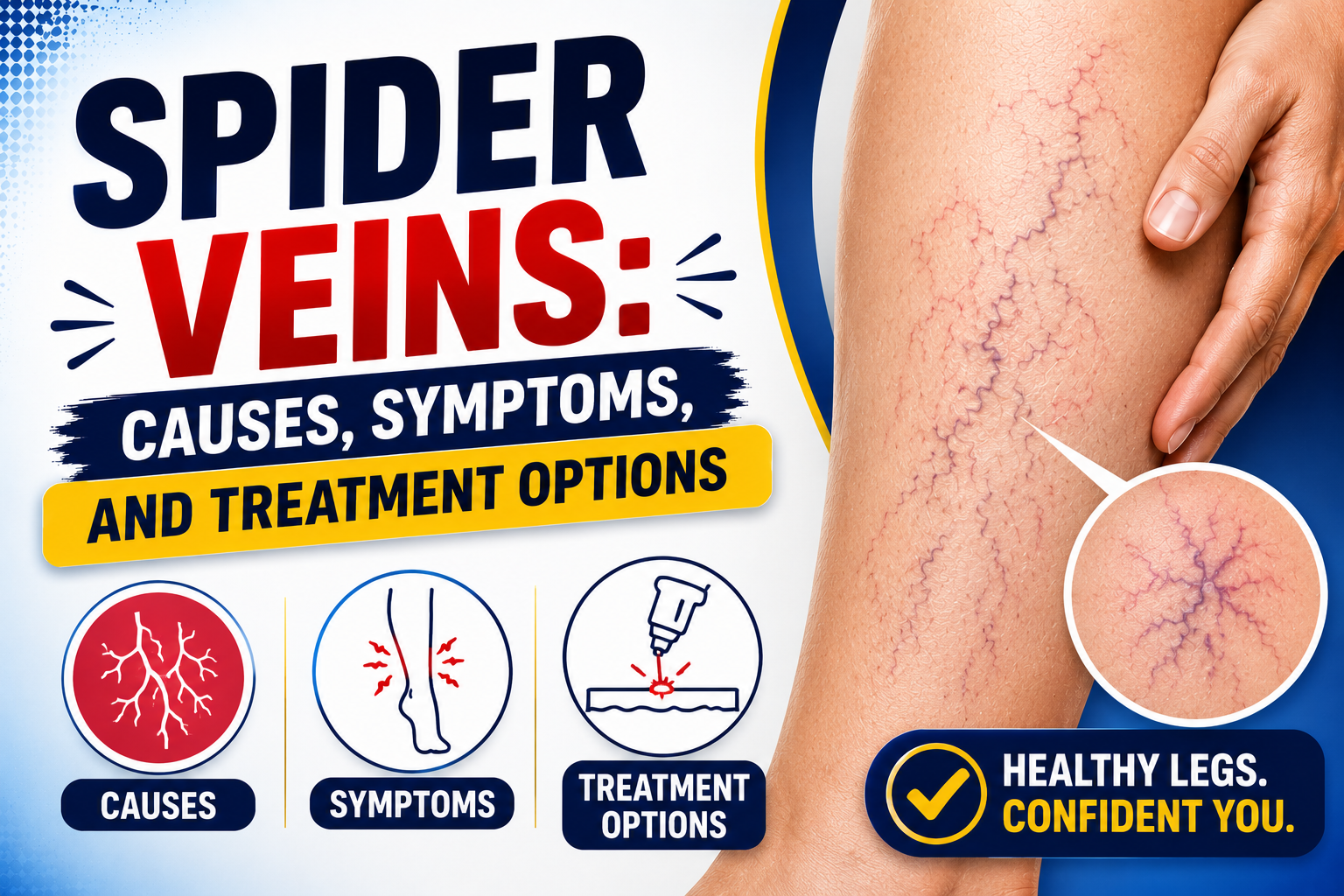
Spider veins – medically known as telangiectasias – are tiny, dilated blood vessels that appear just beneath the surface of the skin. They measure less than 1 mm in diameter and form distinctive web-like, branching, or linear patterns in shades of red, blue, or purple.
Unlike varicose veins – which are large, bulging, and rope-like – spider veins are flat or only slightly raised and generally do not protrude above the skin surface.
They get their name from their appearance – the way the thin lines spread outward from a central point resembles a spider and its web.
Spider veins can appear:
- On the legs and thighs – the most common location
- Around the ankles and feet
- On the face – particularly around the nose, cheeks, and chin
- Occasionally on the chest or hands
Spider Veins vs Varicose Veins - What Is the Difference?
Many people confuse spider veins with varicose veins. While both are caused by problems in the venous system, they are distinctly different conditions.
Factor | Spider Veins | Varicose Veins |
Size | Tiny – less than 1 mm | Large – 3 mm or more |
Appearance | Flat, web-like lines | Bulging, twisted, rope-like |
Color | Red, purple, or blue | Dark blue or purple |
Location | Surface of skin | Deeper beneath skin |
Symptoms | Usually cosmetic only | Pain, swelling, heaviness |
Risk Level | Generally low | Can cause serious complications |
Treatment | Sclerotherapy, surface laser | EVLT laser, surgery |
The key takeaway – spider veins are a milder form of venous disease. However, in some cases, visible spider veins on the legs are a sign that larger varicose veins are developing deeper in the venous system. This is why a proper vascular assessment is always recommended.
What Causes Spider Veins?
Spider veins develop when the walls of tiny blood vessels weaken or when the pressure inside them increases – causing them to dilate and become visible through the skin. Several factors contribute to this:
- Genetics and Family History
The single biggest risk factor for spider veins is heredity. If your parents or siblings have spider veins, you are significantly more likely to develop them yourself. The tendency for weak vein walls and faulty vein valves runs strongly in families.
- Prolonged Standing or Sitting
People who spend long hours on their feet – teachers, healthcare workers, retail staff, security guards – or those who sit for extended periods – IT professionals, office workers – are at higher risk. In both cases, blood pools in the lower leg veins, increasing pressure and causing small vessels to dilate.
- Hormonal Changes
Female hormones – particularly estrogen and progesterone – weaken vein walls. This is why spider veins are significantly more common in women than in men. Hormonal fluctuations during puberty, pregnancy, and menopause all increase risk.
Oral contraceptive pills and hormone replacement therapy (HRT) can also contribute to spider vein development by raising estrogen levels.
- Pregnancy
Pregnancy is one of the most common triggers for spider veins. During pregnancy, blood volume increases by up to 50%, putting enormous pressure on the veins. The growing uterus also compresses the pelvic veins, restricting blood return from the legs. Additionally, pregnancy hormones relax vein walls, making them more prone to dilation.
Spider veins that appear during pregnancy sometimes fade after delivery – but many persist permanently.
- Sun Exposure
On the face, sun exposure is a major cause of spider veins. UV radiation breaks down collagen in the skin and damages the walls of superficial blood vessels – causing them to dilate and become permanently visible. Fair-skinned individuals are particularly prone to facial spider veins.
- Age
As we age, the skin becomes thinner, vein walls lose elasticity, and vein valves weaken – all of which make spider veins more likely to develop and become visible.
- Obesity and Excess Weight
Carrying excess body weight increases the pressure on the veins in the legs and pelvis. Over time, this chronic pressure damages vein walls and valves, promoting spider vein formation.
- Previous Vein Trauma or Injury
A history of blood clots, vein injuries, or previous vein procedures can damage vein walls and contribute to spider vein development in the affected area.
- Alcohol Consumption
Regular alcohol consumption causes vasodilation – widening of blood vessels – and over time can lead to permanently dilated capillaries, particularly on the face and cheeks.
Symptoms of Spider Veins
In many cases, spider veins cause no physical symptoms at all – they are purely a cosmetic concern. However, some patients do experience:
- Mild burning or itching around the affected area
- A feeling of warmth or heat over the spider veins
- Mild aching in the legs after prolonged standing – though this is more commonly associated with underlying reticular or varicose veins
- Self-consciousness or embarrassment about their appearance – particularly when wearing shorts, skirts, or swimwear
If your spider veins are accompanied by significant leg pain, swelling, heaviness, or skin changes – these symptoms suggest deeper varicose vein involvement that needs urgent assessment.
Are Spider Veins Dangerous?
In isolation, spider veins are not medically dangerous. They do not rupture, do not cause blood clots, and do not lead to serious health complications on their own.
However, there are two important exceptions:
- They may indicate underlying venous insufficiency. Spider veins on the legs – especially if widespread – can be a visible sign that the deeper venous system is under pressure. A Doppler ultrasound can determine whether larger varicose veins are developing beneath the surface.
- Facial spider veins from alcohol or liver disease can sometimes indicate more serious underlying health conditions that need medical evaluation.
For the vast majority of patients, spider veins are a cosmetic concern – but one that is entirely treatable.
Treatment Options for Spider Veins
The good news is that spider veins respond very well to modern treatment. There are two main approaches:
Sclerotherapy – The Gold Standard Treatment
Sclerotherapy is the most widely used and most effective treatment for spider veins on the legs. It involves:
- Injecting a chemical solution called a sclerosant directly into the spider vein using an ultra-fine needle
- The sclerosant irritates the vein wall, causing it to swell shut and seal
- The treated vein gradually fades and is absorbed by the body over 4 to 6 weeks
- Multiple veins can be treated in a single session
- No anesthesia required – most patients describe the injections as a mild stinging sensation
- No downtime – you can walk out and return to normal activities immediately after
How many sessions are needed?
Most patients need 2 to 4 sessions spaced 4 to 6 weeks apart for optimal results, depending on the extent of spider veins.
How effective is sclerotherapy?
Clinical studies show that sclerotherapy eliminates 75 to 90% of treated spider veins. Results become visible gradually over 4 to 6 weeks after each session as the body absorbs the treated veins.
Surface Laser Treatment
For very fine spider veins – particularly on the face – or for patients who prefer to avoid injections, surface laser treatment is an excellent option.
- A focused laser beam is directed at the spider vein through the skin surface
- The laser energy heats and destroys the tiny blood vessel without damaging surrounding skin
- No needles, no injections, no incisions
- A mild stinging sensation similar to a rubber band snap is felt during treatment
- Multiple sessions may be required for complete clearance
Surface laser vs sclerotherapy — which is better for spider veins?
For leg spider veins, sclerotherapy is generally more effective and more cost-efficient. For facial spider veins, surface laser is preferred as it avoids injections near delicate facial structures.
Combination Treatment
In many patients – particularly those with both spider veins and underlying reticular or varicose veins – the best results come from a combination approach:
- EVLT laser to treat underlying truncal varicose veins first
- Followed by sclerotherapy to address spider veins and reticular veins
Treating the underlying venous insufficiency first is critical – if you only treat spider veins without addressing the deeper problem, new spider veins will keep appearing.
What to Expect After Spider Vein Treatment
After Sclerotherapy:
- Mild redness, swelling, or bruising around injection sites – normal and resolves within a few days
- Compression stockings to be worn for 1 to 2 weeks after treatment
- Avoid intense exercise, hot baths, saunas, and direct sun exposure for 1 to 2 weeks
- Treated veins gradually fade over 4 to 6 weeks – not immediately
- Final results visible after 3 to 6 months
After Surface Laser:
- Mild redness and warmth over treated area – resolves within a few hours to days
- Avoid sun exposure and apply SPF 50 sunscreen diligently for at least 4 weeks
- Multiple sessions spaced 4 to 6 weeks apart for best results
Can Spider Veins Be Prevented?
While you cannot completely prevent spider veins – especially if you have a genetic predisposition – these measures significantly reduce your risk and slow progression:
- Wear compression stockings if you stand or sit for long hours at work
- Exercise regularly – walking and swimming are particularly effective for improving leg circulation
- Maintain a healthy weight to reduce pressure on leg veins
- Elevate your legs for 15 to 20 minutes daily after long periods of standing
- Avoid prolonged sitting or standing in one position – take movement breaks every 30 to 40 minutes
- Use high SPF sunscreen daily on exposed facial skin to prevent UV-induced spider veins
- Limit alcohol consumption – particularly to prevent facial spider veins
- Avoid tight clothing around the waist or thighs that restricts blood flow
- Wear comfortable, low-heeled footwear that supports healthy calf muscle function
When Should You See a Doctor for Spider Veins?
See a vascular specialist if:
- Your spider veins are spreading rapidly or increasing in number
- You experience burning, itching, or aching around the veins
- You notice spider veins accompanied by leg swelling, heaviness, or skin changes
- You are concerned about their appearance and want to explore treatment
- You have a family history of varicose veins and want a preventive vascular assessment
Even if your spider veins cause no symptoms, a consultation with a vascular specialist is worthwhile – a Doppler ultrasound can rule out underlying venous insufficiency and give you complete peace of mind.
Spider Vein Treatment at Hari Laser Clinics, Bangalore
At Hari Laser Clinics, Bangalore, we offer comprehensive spider vein treatment tailored to each patient’s specific condition and aesthetic goals.
What we offer:
- Expert consultation with experienced vascular surgeons
- Venous Doppler ultrasound to assess for underlying varicose veins
- Sclerotherapy for leg spider veins
- Surface laser treatment for facial and fine spider veins
- Combination treatment for patients with both spider veins and varicose veins
- Transparent pricing with no hidden charges
- Convenient location in Bangalore
Frequently Asked Questions
No. Spider veins are much smaller, flatter, and generally cause no physical symptoms. Varicose veins are larger, bulging, and can cause significant pain, swelling, and serious complications if untreated. Both indicate venous disease but differ significantly in severity.
Spider veins that appear during pregnancy sometimes fade after delivery. In most other cases, spider veins do not disappear on their own and require treatment if removal is desired.
Most patients experience only a mild stinging or burning sensation during injection – similar to a small insect bite. The procedure is very well tolerated and requires no anesthesia.
Most patients need 2 to 4 sessions for optimal results. The exact number depends on the extent and distribution of spider veins. Sessions are spaced 4 to 6 weeks apart.
Treated spider veins do not return – once a vein is destroyed and absorbed by the body, it is gone permanently. However, new spider veins can develop over time in other areas, particularly if underlying risk factors are not addressed.
Yes. Sclerotherapy has been used safely for decades and is approved by international medical bodies. Serious complications are extremely rare when the procedure is performed by a trained specialist.
Yes. While spider veins are significantly more common in women due to hormonal factors, men can and do develop spider veins – particularly those in high-risk occupations involving prolonged standing.
Conclusion
Spider veins are one of the most common vein conditions in India – affecting millions of people across all age groups. While they are rarely dangerous, they can cause cosmetic distress, occasional discomfort, and in some cases signal deeper venous disease that needs attention.
The reassuring truth is that spider veins are entirely treatable. With modern sclerotherapy and laser treatments, most patients achieve significant clearance with minimal discomfort and zero downtime.
Do not let spider veins affect your confidence or quality of life. Early treatment is simple, effective, and affordable.
Concerned about spider veins? Consult our vascular surgery experts at Hari Laser Clinics, Bangalore for a complete assessment and personalized treatment plan.