
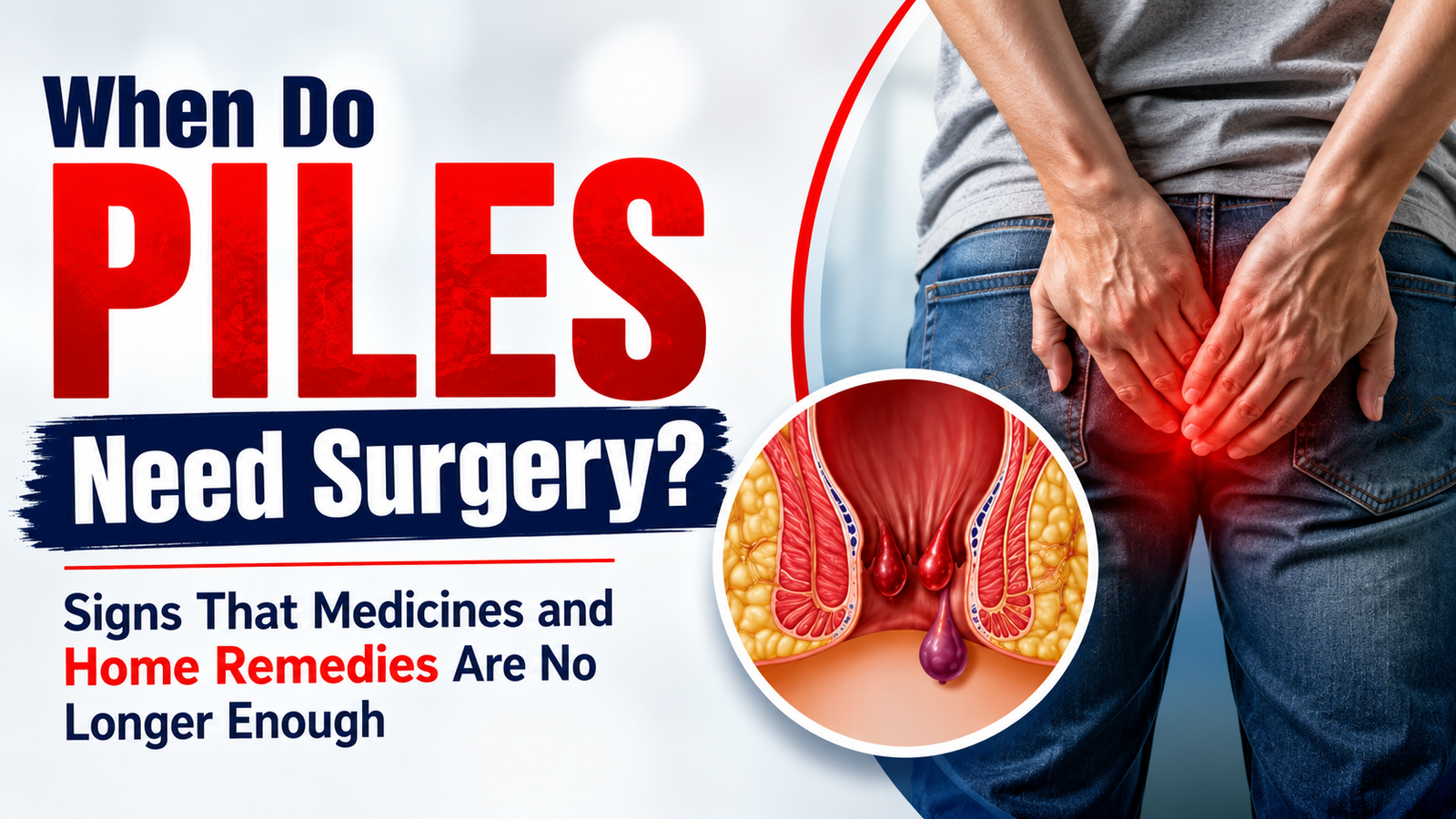
When Do Piles Need Surgery? Signs That Medicines and Home Remedies Are No Longer Enough
A complete guide to recognising when conservative treatment is not enough — and how modern Laser Piles Surgery at Hari Laser Clinics can provide lasting relief.
🗓️ Updated June 2026 ⏱️ 10 min read 🩺 Reviewed by Hari Laser Clinics Specialist Team
While lifestyle changes and medications are effective for many people with early-stage piles, they do not work for everyone. As haemorrhoids become larger or more advanced, the swollen tissue may no longer respond to conservative treatment. If your symptoms persist despite following your doctor’s advice, it may be time to consider a more permanent solution.
Recognising these warning signs early can help prevent complications and improve your quality of life.
When Are Medicines and Home Remedies No Longer Enough?
Persistent Bleeding During Bowel Movements
One of the most common symptoms of piles is bleeding during bowel movements. In the early stages, occasional spotting may improve with dietary changes and medication. However, if you continue to notice bright red blood regularly despite treatment, it should never be ignored.
Persistent bleeding may indicate that the haemorrhoids have enlarged or become more severe. Over time, repeated blood loss can also lead to iron deficiency anaemia, causing symptoms such as fatigue, weakness, dizziness, and reduced stamina. If bleeding becomes frequent or heavy, consult a specialist for a proper evaluation.
Severe Pain That Doesn't Improve
Although internal piles are often painless, advanced piles or external haemorrhoids can cause significant discomfort. If pain continues despite using medicines, warm sitz baths, and lifestyle modifications, it may indicate complications such as:
- Thrombosed external piles
- Strangulated prolapsed piles
- Severe inflammation
- Swelling around the anus
Pain that affects your ability to sit, walk, work, or sleep should be assessed by a specialist without delay.
Prolapsed Piles That Remain Outside
As internal haemorrhoids progress, they may begin to protrude through the anus during bowel movements. Initially, they return inside naturally. Later, they may need to be pushed back manually. Eventually, they may remain permanently outside — known as Grade IV piles. Medicines alone are unlikely to provide lasting relief at this stage, and surgical treatment is often the most effective option.
Recurrent Symptoms Despite Medication
Some patients experience temporary improvement after taking medicines, only for symptoms to return repeatedly. Ongoing bleeding, pain, itching, swelling, burning sensation, or difficulty passing stools despite completing medical treatment suggests that procedural intervention may be required rather than repeated courses of medication.
Grade III and Grade IV Haemorrhoids
The grade of piles plays a major role in deciding treatment. Grade III piles often prolapse during bowel movements and require manual repositioning, with patients frequently experiencing repeated bleeding, discomfort, and irritation. Grade IV piles remain permanently prolapsed and may cause persistent pain, swelling, hygiene difficulties, and an increased risk of complications. For many patients with advanced grades, surgery provides the most reliable long-term relief.
| Grade | Description | Typical Recommendation |
|---|---|---|
| Grade I | Small, remain inside rectum | Conservative / IRC |
| Grade II | Prolapse during straining, retract naturally | Rubber Band Ligation / Laser |
| Grade III | Prolapse, require manual repositioning | Laser Surgery / Stapler |
| Grade IV | Permanently prolapsed outside | Laser / Haemorrhoidectomy |
Other Signs That Surgery May Be Needed
Thrombosed External Piles
Sometimes, blood collects inside an external haemorrhoid, forming a clot known as a thrombosed haemorrhoid. This can cause sudden severe pain, a hard lump near the anus, swelling, tenderness, and bluish or purple discoloration. Depending on the severity and duration of symptoms, your doctor may recommend surgical treatment to relieve pain and promote faster recovery.
Difficulty Performing Daily Activities
Piles should not interfere with your everyday life. If symptoms make it difficult to sit comfortably, walk, drive, exercise, work efficiently, or sleep peacefully, conservative treatment may no longer be sufficient. The goal of treatment is not only to eliminate piles but also to restore comfort and improve your overall quality of life.
Chronic Constipation and Painful Bowel Movements
Advanced piles often create a vicious cycle — pain during bowel movements causes patients to delay passing stools, leading to constipation, harder stools, increased straining, and further enlargement of the haemorrhoids. Breaking this cycle can be difficult with medicines alone, making surgical treatment a more effective long-term solution.
Poor Quality of Life
Many patients continue living with piles because they fear surgery or assume the symptoms are something they simply have to tolerate. However, if piles are causing constant discomfort, frequent bleeding, anxiety before bowel movements, reduced work productivity, sleep disturbances, or social embarrassment — it is worth consulting a specialist. Modern laser procedures have made piles treatment much less painful and far more comfortable than many people expect.
What Happens If Advanced Piles Are Left Untreated?
Ignoring advanced piles can allow the condition to progress, increasing both discomfort and the risk of complications. Although piles are not usually life-threatening, untreated haemorrhoids can significantly affect your health and daily routine.
⚠️ Potential Complications of Untreated Advanced Piles
- Chronic bleeding leading to iron deficiency anaemia — tiredness, weakness, dizziness, poor concentration
- Persistent and increasingly severe pain affecting sitting, travelling, and working
- Strangulated haemorrhoids — blood supply cut off, causing severe pain, swelling, and tissue damage
- Thrombosed haemorrhoids — sudden intense pain and swelling from blood clots
- Infection and inflammation due to persistent swelling and tissue damage
- Difficulty passing stools — worsening constipation and increased straining
- Reduced quality of life — avoiding travel, physical activity, and social situations
How Do Doctors Decide If Surgery Is Needed?
Not every patient with piles requires surgery. Before recommending treatment, a specialist performs a detailed evaluation to determine the severity of the condition and identify the most appropriate management plan.
Medical History
Duration of symptoms, bleeding, pain, prolapse, previous treatments, constipation, lifestyle habits, and full medical history.
Physical Examination
External piles, swelling, skin changes, prolapse, tenderness, and signs of complications.
Digital Rectal Examination
Helps assess internal abnormalities and rule out other causes of symptoms when necessary.
Anoscopy / Proctoscopy
Examines the anal canal and lower rectum to determine grade, bleeding source, degree of prolapse, and other anorectal conditions.
Colonoscopy (If Required)
Recommended if rectal bleeding requires further evaluation or another bowel condition needs to be ruled out.
Personalised Treatment Plan
After evaluation, the doctor considers grade, symptom severity, bleeding frequency, pain level, general health, and previous treatment response.
Modern Treatment Options for Piles
Treatment for piles depends on the severity of the condition, the grade of the haemorrhoids, your symptoms, and how well you have responded to medications or lifestyle changes. At Hari Laser Clinics, every patient undergoes a detailed evaluation before a personalised treatment plan is recommended.
Conservative Management
High-fiber diet, increased water intake, regular physical activity, stool softeners, sitz baths, medications to reduce pain and inflammation. Effective for mild piles — cannot remove enlarged haemorrhoidal tissue or repair advanced piles.
Rubber Band Ligation
A small rubber band placed around the base of the haemorrhoid cuts off its blood supply, causing the tissue to shrink and fall off. Suitable for selected Grade I and Grade II internal piles. Outpatient procedure.
Infrared Coagulation (IRC)
Uses infrared energy to shrink small internal haemorrhoids by reducing their blood supply. Generally recommended for Grade I piles and mild bleeding. Quick recovery.
Stapler Surgery
Repositions prolapsed tissue back into its normal position while reducing its blood supply. Less post-operative pain and faster recovery compared to conventional surgery for selected patients.
Conventional Haemorrhoidectomy
Traditional surgical method used to remove large or complicated haemorrhoids. Recommended for very large external haemorrhoids, advanced Grade IV piles, recurrent haemorrhoids, and complex cases.
⭐ Laser Piles Surgery
One of the most advanced treatment options. Using precise laser energy, enlarged haemorrhoidal tissue is treated with minimal damage to surrounding healthy tissue — offering effective symptom relief and faster healing.
Why Laser Piles Surgery Is Becoming the Preferred Choice
Advances in medical technology have made piles treatment much more comfortable than it was in the past. Today, many patients choose laser piles surgery because it is minimally invasive and allows them to recover faster with less discomfort.
🎯 Minimally Invasive
Precisely targets affected haemorrhoidal tissue while preserving surrounding healthy structures — smaller wounds, less tissue trauma, greater comfort.
🩹 Minimal Bleeding
Laser energy seals small blood vessels during the procedure, reducing bleeding both during and after treatment for a cleaner procedure and faster healing.
💊 Less Pain After Treatment
Because laser surgery causes minimal damage to surrounding tissue, many patients experience significantly less post-operative pain compared to traditional surgery.
🏠 Day-Care Procedure
Most patients are discharged on the same day after a short period of observation, allowing them to recover comfortably at home.
⚡ Faster Recovery
Many patients are able to walk on the same day, resume light activities within a few days, and return to work earlier than with conventional surgery.
✅ Lower Risk of Complications
Minimally invasive approach means lower risk of excessive bleeding, infection, delayed wound healing, and significant post-operative discomfort.
Recovery After Laser Piles Surgery
Recovery after laser piles surgery is generally quicker and more comfortable than after conventional surgery. Most patients experience less pain, minimal bleeding, and a shorter healing period. Immediately after the procedure, it is normal to have mild discomfort, slight swelling, or minimal spotting — these symptoms usually improve within a few days.
During recovery, your doctor may recommend:
- Taking prescribed medications as directed
- Drinking plenty of water and eating a high-fibre diet
- Avoiding constipation and straining
- Taking warm sitz baths if advised
- Walking regularly to improve circulation
- Avoiding heavy lifting until cleared by your doctor
- Attending follow-up appointments to ensure proper healing
Many patients with desk jobs can resume work within a few days, while those with physically demanding occupations may need a little more recovery time.
Can You Prevent Piles From Coming Back?
Although surgery treats existing haemorrhoids, healthy lifestyle habits can help reduce the risk of developing new piles in the future.
- Eat a fibre-rich diet every day
- Drink adequate water throughout the day
- Avoid excessive straining during bowel movements
- Stay physically active
- Maintain a healthy body weight
- Don't delay the urge to pass stools
- Limit prolonged sitting, especially at work
- Manage constipation promptly
- Follow your doctor's advice after treatment
Why Choose Hari Laser Clinics?
At Hari Laser Clinics, we believe that effective piles treatment should focus on both symptom relief and long-term patient comfort. Our experienced team combines accurate diagnosis with advanced minimally invasive procedures to deliver personalised care for every patient.
- Experienced laser and proctology specialists
- Comprehensive evaluation and accurate diagnosis
- Advanced Laser Piles Surgery for suitable patients
- Personalised treatment plans — no unnecessary surgery
- Day-care procedures with minimal hospital stay
- Less pain and quicker recovery
- Patient-centred care and dedicated follow-up
- Guidance on lifestyle changes to reduce recurrence
🏥 Our Goal
To help every patient return to a healthier, more comfortable, and active lifestyle with confidence.
Symptoms Not Improving? Consult Our Piles Specialists Today
At Hari Laser Clinics, our specialists will evaluate your condition and recommend the right treatment — from conservative care to advanced Laser Piles Surgery — for lasting relief.
Frequently Asked Questions
When should I consider surgery for piles?
Can Grade III piles be treated without surgery?
Is Laser Piles Surgery painful?
How long does Laser Piles Surgery take?
How soon can I return to work?
Can piles come back after surgery?
What happens if bleeding piles are left untreated?
Is Laser Piles Surgery suitable for everyone?
This article is for informational purposes only and does not substitute professional medical advice. Please consult a qualified specialist at Hari Laser Clinics for diagnosis and treatment tailored to your condition.