
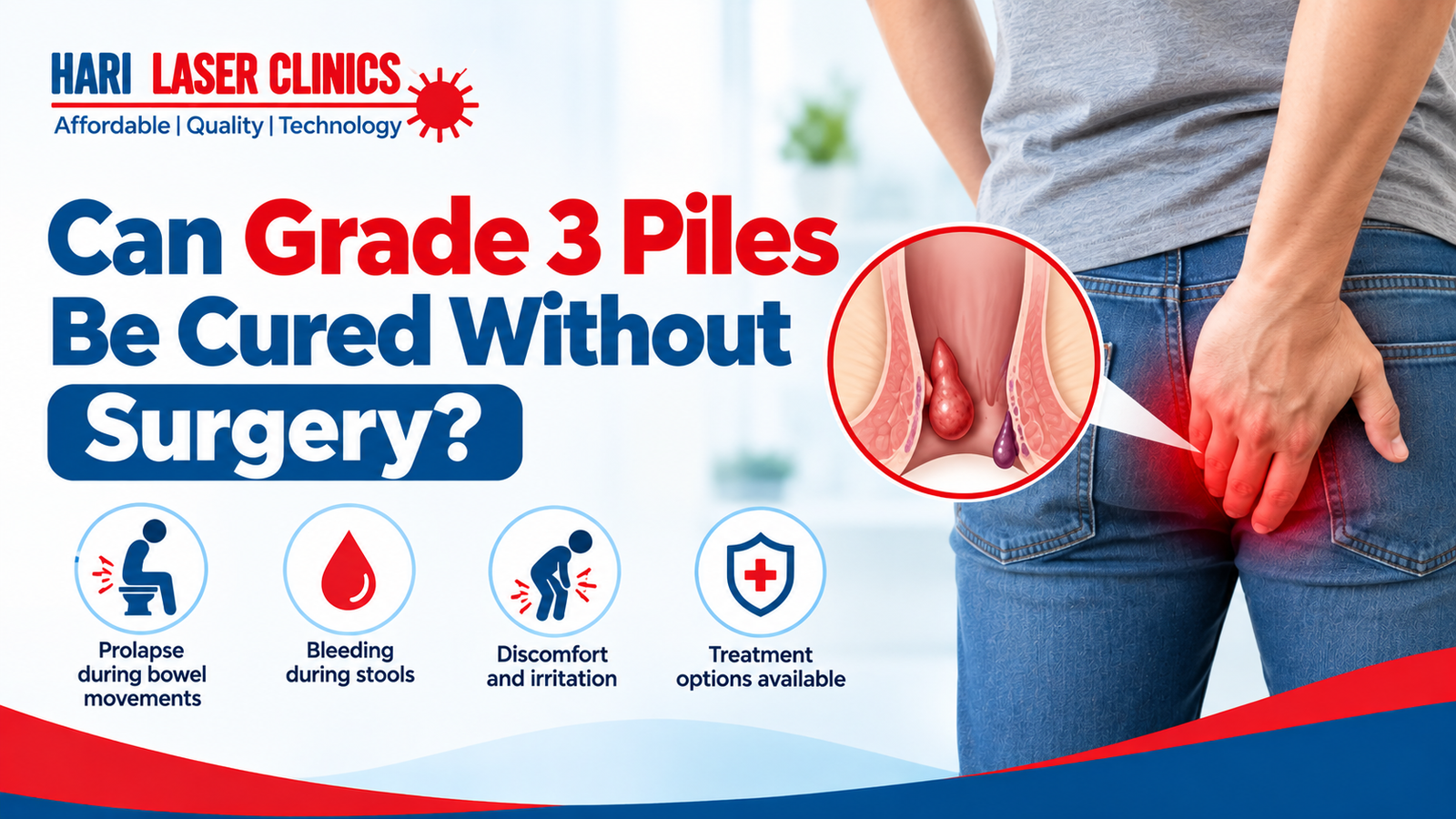
Can Grade 3 Piles Be Cured Without Surgery?
Grade 3 piles come out during bowel movements and need to be pushed back. Here is what medicines and lifestyle changes can and cannot do, the signs you need more than that, and the treatment options available.
Grade 3 piles are an advanced form of internal haemorrhoids that can cause bleeding, discomfort, swelling, and prolapse during bowel movements. Unlike Grade 1 piles, which usually remain inside the rectum, or Grade 2 piles, which return inside on their own, Grade 3 piles protrude through the anus during bowel movements and usually need to be pushed back manually.
One of the most common questions patients ask after being diagnosed with Grade 3 piles is: "Can Grade 3 piles be cured without surgery?"
The answer depends on the severity of the symptoms, the degree of prolapse, the frequency of bleeding, and how well the condition responds to conservative treatment.
Can Grade 3 piles be cured without surgery? Some patients with Grade 3 piles may experience significant symptom relief through dietary changes, medicines, fibre, improved bowel habits, and other non-surgical measures. However, these treatments do not necessarily eliminate the underlying enlarged haemorrhoidal tissue. If the piles continue to prolapse, bleed repeatedly, cause significant discomfort, or return despite treatment, a minimally invasive procedure or surgery may be recommended.
The important thing is not to assume that every Grade 3 haemorrhoid requires immediate conventional surgery. Modern piles treatment includes several options, and the appropriate approach depends on an individual medical assessment.
What Are Grade 3 Piles?
Piles, medically known as haemorrhoids, are swollen veins and supporting tissues inside or around the anal canal. They can develop when increased pressure affects the veins, particularly with chronic constipation, repeated straining, prolonged sitting, pregnancy, obesity, and other factors.
Internal haemorrhoids are commonly classified into four grades according to how far they prolapse.
Grade 1 Piles
Grade 1 piles remain inside the rectum and do not protrude through the anus. Bleeding during bowel movements may be the main symptom.
Grade 2 Piles
Grade 2 piles come out during bowel movements or straining but return inside naturally after the bowel movement is over.
Grade 3 Piles
Grade 3 piles prolapse through the anus during bowel movements and usually need to be pushed back manually.
Grade 4 Piles
Grade 4 piles remain outside the anus and cannot be pushed back inside. They are the most advanced grade of internal haemorrhoids and generally require specialist treatment.
With Grade 3 piles, patients may experience:
- Bright red bleeding
- Prolapse during bowel movements
- A feeling of incomplete bowel emptying
- Anal discomfort
- Itching or irritation
- Swelling
- Mucus discharge
- Difficulty maintaining hygiene
- Pain or discomfort, particularly when complications occur
Understanding the difference between these grades is important because the treatment approach changes as haemorrhoids become more advanced.
Can Grade 3 Piles Be Cured Without Surgery?
In some cases, the symptoms of Grade 3 piles can be controlled without conventional surgery, but not every patient can achieve lasting relief through medicines and lifestyle changes alone.
This distinction is important.
Conservative treatment can improve bowel habits, reduce constipation, decrease straining, and relieve symptoms. However, if the haemorrhoidal tissue has become significantly enlarged and repeatedly prolapses, lifestyle changes alone may not permanently correct the prolapse.
For a patient with Grade 3 piles, doctors may initially consider non-surgical measures when symptoms are manageable and there are no significant complications. These may include:
- Increasing dietary fibre
- Drinking adequate water
- Using fibre supplements when required
- Treating constipation
- Avoiding excessive straining
- Taking prescribed medicines
- Regular physical activity
- Maintaining a healthy weight
- Avoiding prolonged sitting on the toilet
- Using warm sitz baths for symptom relief
If symptoms improve and remain controlled, continued conservative management may be appropriate under medical guidance.
However, if the piles continue to prolapse or symptoms repeatedly return, a procedure may provide more definitive relief.
Why Grade 3 Piles Are Different From Early-Stage Piles
The main difference between Grade 3 piles and early-stage haemorrhoids is prolapse.
- Grade 1: the swollen tissue remains inside
- Grade 2: the tissue comes out during bowel movements but returns inside naturally
- Grade 3: the tissue requires manual repositioning
This means that the supporting tissues and haemorrhoidal structures have undergone a greater degree of change.
Medicines can help control:
- Bleeding
- Inflammation
- Pain
- Itching
- Constipation
- Irritation
But they may not be able to reverse established prolapse.
That is why treatment decisions for Grade 3 piles should be based on both symptom control and the physical severity of the haemorrhoids.
What Non-Surgical Treatments Can Help Grade 3 Piles?
If your doctor determines that conservative treatment is appropriate, several measures may help reduce symptoms and prevent further aggravation.
1. High-Fibre Diet
Increasing fibre intake helps make stools softer and easier to pass. Good sources of fibre include:
- Fruits
- Vegetables
- Whole grains
- Oats
- Beans
- Lentils
- Seeds
Softer stools reduce the need to strain, which can decrease pressure on the haemorrhoidal veins.
2. Fibre Supplements
If dietary fibre is not sufficient, a doctor may recommend a fibre supplement. The aim is to improve stool consistency and make bowel movements easier. However, fibre should generally be increased gradually and accompanied by adequate fluid intake.
3. Adequate Hydration
Drinking enough water helps prevent hard stools and constipation. When combined with a fibre-rich diet, adequate hydration can support smoother bowel movements and reduce straining.
4. Avoid Straining
Repeated straining increases pressure inside the veins around the rectum. Try to avoid:
- Sitting on the toilet for long periods
- Forcefully pushing during bowel movements
- Delaying bowel movements for long periods
- Spending excessive time using a mobile phone on the toilet
Developing healthier bowel habits can reduce repeated pressure on haemorrhoidal tissues.
5. Medicines
Depending on your symptoms, your doctor may prescribe medications to control pain, inflammation, itching, or constipation. Medicines can make symptoms more manageable, but they do not necessarily remove prolapsed Grade 3 haemorrhoidal tissue. If symptoms return repeatedly after stopping treatment, further evaluation may be necessary.
6. Warm Sitz Baths
A warm sitz bath may help relieve irritation and discomfort around the anal area. It can be particularly useful after bowel movements when the area feels irritated. However, sitz baths provide symptomatic relief rather than correcting the underlying prolapse.
7. Regular Physical Activity
Regular exercise can support healthy bowel function and help prevent constipation. Walking is a simple option for most people. Other activities may include:
- Swimming
- Cycling
- Yoga
- Light exercise
If a particular activity increases your symptoms, discuss it with your doctor.
When Is Non-Surgical Treatment Not Enough for Grade 3 Piles?
There are several warning signs that suggest conservative treatment may no longer be sufficient.
Piles Keep Prolapsing
If the haemorrhoids continue to come outside during bowel movements and repeatedly need to be pushed back, the underlying prolapse may require procedural treatment.
Frequent Bleeding
Occasional bleeding may occur with haemorrhoids, but frequent or persistent bleeding should be evaluated. Repeated blood loss can sometimes contribute to anaemia. Importantly, not every episode of rectal bleeding is caused by piles. Persistent or unexplained bleeding should always be assessed by a doctor.
Symptoms Keep Returning
If medicines provide temporary relief but symptoms repeatedly return, the underlying haemorrhoidal tissue may require more definitive treatment. Repeated courses of medication without addressing persistent prolapse may not provide a long-term solution.
Pain or Discomfort Affects Daily Life
Grade 3 piles can become particularly troublesome when symptoms interfere with sitting, walking, working, exercising, travelling, sleeping or passing stools. When symptoms significantly affect quality of life, discussing procedural options with a specialist is reasonable.
Difficulty Pushing the Piles Back
If previously manageable prolapse becomes increasingly difficult to push back, this may indicate progression or complications. A specialist examination can determine whether the piles remain suitable for conservative treatment.
Find out what your piles actually need. Get a detailed piles evaluation at Hari Laser Clinics, including laser options for suitable patients.
Does Grade 3 Piles Always Need Surgery?
No. Grade 3 piles do not automatically mean that conventional surgery is required.
Treatment depends on the individual case. Some patients may initially be managed with conservative measures. Others may benefit from minimally invasive procedures if symptoms persist.
The important factors include:
- Frequency of prolapse
- Degree of bleeding
- Severity of discomfort
- Constipation and bowel habits
- Response to previous treatment
- Presence of complications
- Overall health
- Patient preferences
A specialist can determine whether continued medical management, a minimally invasive procedure, or surgery is appropriate.
What Procedures Can Treat Grade 3 Piles?
When conservative treatment does not provide adequate relief, several procedures may be considered.
Rubber Band Ligation
Rubber Band Ligation is commonly used for selected internal haemorrhoids. A small rubber band is placed around the base of the haemorrhoidal tissue. This cuts off its blood supply, causing the tissue to shrink and eventually fall away. It may be suitable for selected patients depending on the size and location of the haemorrhoids.
Stapled Haemorrhoidopexy
Stapled haemorrhoidopexy repositions prolapsed internal haemorrhoidal tissue and reduces its blood supply. It may be considered for selected patients with prolapsing internal haemorrhoids. The suitability of this procedure depends on the individual anatomy and severity of the condition.
Conventional Haemorrhoidectomy
A haemorrhoidectomy involves surgically removing the enlarged haemorrhoidal tissue. It may be recommended for certain advanced or complicated cases. Although effective, conventional surgery may involve more post-operative discomfort and a longer recovery compared with some minimally invasive approaches.
Laser Piles Treatment
Laser treatment may be an option for selected patients with Grade 3 piles. It uses controlled laser energy to treat the affected haemorrhoidal tissue while minimising trauma to surrounding areas. See the section below for details.
Is Laser Treatment an Option for Grade 3 Piles?
Laser treatment may be an option for selected patients with Grade 3 piles.
Laser piles procedures use controlled laser energy to treat the affected haemorrhoidal tissue while minimising trauma to surrounding areas. The exact technique used depends on the patient's condition and the doctor's assessment.
Potential advantages of minimally invasive laser treatment may include:
- Minimal tissue damage
- Less post-procedure discomfort
- Minimal bleeding
- No large surgical cuts
- Shorter recovery
- Early return to daily activities
- Day-care treatment in suitable cases
However, laser treatment is not automatically the right option for every Grade 3 haemorrhoid. The doctor needs to assess the degree of prolapse, the number and size of haemorrhoids, symptoms, and other clinical factors before recommending treatment.
Laser Piles Treatment vs Managing Grade 3 Piles With Medicines
It is important to understand that these approaches serve different purposes.
| Medicines and Lifestyle Changes | Procedural Treatment |
|---|---|
| Reduce symptoms | Considered when the haemorrhoidal tissue continues to prolapse |
| Improve bowel movements | Considered when symptoms remain troublesome despite conservative management |
| Reduce constipation and minimise straining | Addresses the physical haemorrhoidal tissue |
| Prevent further irritation | Chosen according to the severity of the piles |
Therefore, the question is not simply "medicine or surgery?"
The more useful question is: "What treatment is appropriate for the severity of my Grade 3 piles?"
A proper examination can answer that question more accurately.
How Are Grade 3 Piles Diagnosed?
An accurate diagnosis is important because rectal bleeding and anal discomfort can have several causes.
Your doctor may begin with a detailed medical history, asking about:
- Bleeding
- Pain
- Prolapse
- Constipation
- Bowel habits
- Previous piles treatment
- Family history
- Other medical conditions
A physical examination may then be performed.
Depending on your symptoms, the doctor may recommend an anoscopy or proctoscopy to examine the anal canal and identify the extent of the haemorrhoids.
In some patients with persistent or unexplained rectal bleeding, additional evaluation such as colonoscopy may be considered to rule out other causes.
What Happens If Grade 3 Piles Are Left Untreated?
Not every Grade 3 haemorrhoid will immediately develop serious complications. However, persistent symptoms should not be ignored. Untreated or progressively worsening haemorrhoids may lead to:
Recurrent Bleeding
Repeated bleeding may eventually contribute to anaemia in some patients.
Increasing Prolapse
The haemorrhoids may become increasingly difficult to push back inside.
Thrombosis
A blood clot can form within an external haemorrhoid, causing significant pain and swelling.
Strangulation
A prolapsed haemorrhoid can occasionally become trapped, affecting its blood supply and causing severe pain and swelling.
Persistent Irritation
Prolapsed tissue can make cleaning difficult and may cause ongoing itching, irritation, or discomfort.
Reduced Quality of Life
Repeated bleeding, discomfort, and anxiety around bowel movements can affect work, travel, exercise, and everyday activities.
For these reasons, persistent Grade 3 piles should be evaluated rather than repeatedly self-treated.
How Can You Prevent Grade 3 Piles From Getting Worse?
Lifestyle changes remain important even when a procedure is being considered.
Maintain a High-Fibre Diet
Include fruits, vegetables, whole grains, legumes, and other fibre-rich foods.
Drink Enough Water
Adequate fluid intake helps maintain softer stools.
Avoid Excessive Straining
Do not force bowel movements.
Don't Sit on the Toilet for Too Long
Prolonged toilet sitting can increase pressure around the anal area.
Exercise Regularly
Regular physical activity supports bowel function and overall health.
Maintain a Healthy Weight
Excess weight can contribute to increased pressure around the pelvic region.
Treat Constipation Early
Do not allow constipation to become a persistent problem.
These measures can help reduce symptoms and may also reduce the likelihood of recurrent haemorrhoidal problems.
When Should You See a Piles Specialist?
You should consider a medical evaluation if you experience:
- Repeated rectal bleeding
- Piles that come out during bowel movements
- Piles that need to be pushed back manually
- Persistent anal discomfort
- Recurrent swelling
- Severe or sudden pain
- Difficulty passing stools
- Symptoms that continue despite medicines and home remedies
Most importantly, do not assume that every episode of rectal bleeding is caused by piles. A proper diagnosis is important, particularly when bleeding is persistent, recurrent, or associated with other symptoms.
Why Choose Hari Laser Clinics for Grade 3 Piles Treatment?
At Hari Laser Clinics, the treatment approach begins with understanding the severity of the haemorrhoids rather than recommending the same procedure for every patient.
Evaluation may include assessment of symptoms, prolapse, bowel habits, previous treatment, and the overall condition of the haemorrhoids.
Based on the findings, appropriate piles treatment options may include conservative management, minimally invasive procedures, or surgical treatment when necessary.
Our approach includes:
- Detailed evaluation of piles
- Assessment of haemorrhoid grade
- Individualised treatment planning
- Advanced minimally invasive treatment options
- Laser piles treatment for suitable patients
- Focus on reducing discomfort and recovery time
- Post-treatment guidance
- Advice on preventing recurrence
The objective is to treat the underlying problem appropriately while avoiding unnecessary intervention.
Frequently Asked Questions
1. Can Grade 3 piles be cured without surgery?
Some Grade 3 piles can have their symptoms controlled with dietary changes, medicines, fibre, improved bowel habits, and other conservative measures. However, if the piles continue to prolapse or symptoms repeatedly return, a minimally invasive procedure or surgery may be required.
2. Can Grade 3 piles go away on their own?
Grade 3 piles are unlikely to completely disappear simply by waiting. Lifestyle changes can reduce symptoms and prevent worsening, but established prolapse may require medical or procedural treatment.
3. Can Grade 3 piles be treated with medicines?
Medicines can help manage symptoms such as pain, itching, inflammation, and constipation. However, they may not correct the physical prolapse associated with Grade 3 piles.
4. Is surgery the only treatment for Grade 3 piles?
No. Treatment options may include conservative management, minimally invasive procedures, and surgery. The appropriate choice depends on the patient's symptoms and clinical examination.
5. Can laser treatment be used for Grade 3 piles?
Laser treatment may be suitable for selected patients with Grade 3 piles. A specialist needs to evaluate the haemorrhoids before determining whether laser treatment is appropriate.
6. Is Grade 3 piles dangerous?
Grade 3 piles are an advanced form of internal haemorrhoids but are not automatically dangerous. However, persistent bleeding, severe pain, increasing prolapse, or complications require medical attention.
7. Can Grade 3 piles become Grade 4?
Yes. Progressive prolapse can cause haemorrhoids to become permanently prolapsed. Grade 4 piles cannot be pushed back inside and generally require specialist treatment.
8. Can fibre cure Grade 3 piles?
Fibre can help soften stools and reduce straining, which may improve symptoms. However, fibre alone may not eliminate established Grade 3 prolapse.
9. How do I know if my Grade 3 piles need surgery?
If piles repeatedly prolapse, require manual repositioning, bleed frequently, cause significant discomfort, or continue despite appropriate conservative treatment, a specialist may recommend a procedure.
10. Can Grade 3 piles come back after treatment?
New haemorrhoids can develop even after successful treatment, particularly if constipation, excessive straining, prolonged sitting, or other risk factors continue. Maintaining healthy bowel habits can help reduce recurrence.
Conclusion
Can Grade 3 piles be cured without surgery? Some patients can manage symptoms with fibre, hydration, exercise, medicines, and healthy bowel habits. However, Grade 3 piles prolapse and usually need to be pushed back manually, so these measures may not correct the underlying prolapse.
If bleeding, prolapse, pain, or symptoms continue despite treatment, a minimally invasive procedure such as laser piles treatment may be considered. The right treatment depends on the severity of the condition and should be decided after a specialist evaluation.
At Hari Laser Clinics, patients receive detailed evaluation and personalised treatment planning, including advanced laser treatment for suitable cases.
Detailed evaluation, grade assessment and personalised treatment planning, including advanced laser piles treatment for suitable cases, at Hari Laser Clinics, Bangalore.
Related Reading
This article is for general information and does not replace a consultation with a qualified doctor. Treatment suitability, including laser treatment, depends on clinical examination. Persistent or unexplained rectal bleeding should always be assessed by a doctor.