
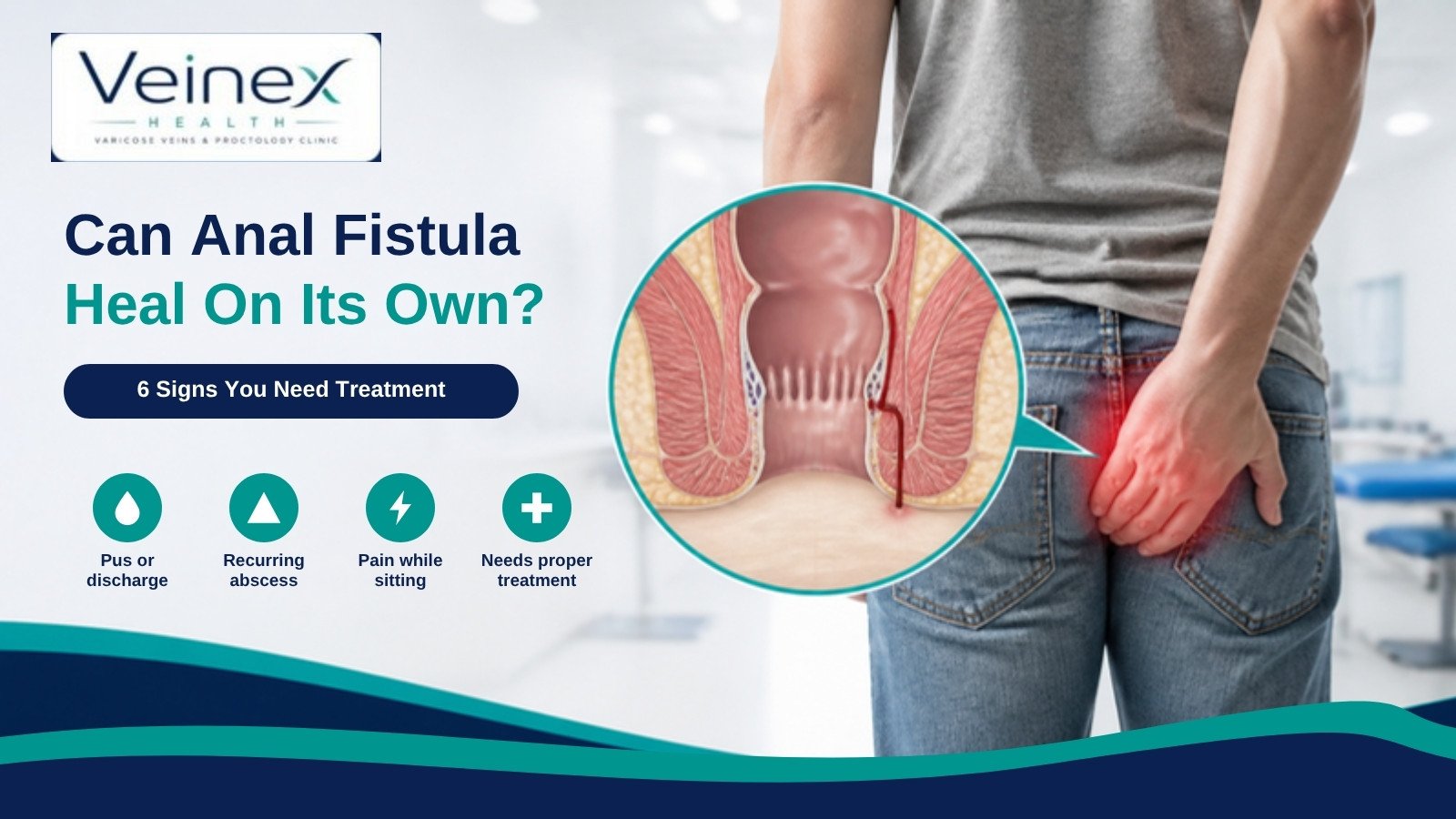
An anal fistula is a small tunnel that forms between the inside of the anal canal and the skin around the anus. It usually develops after an anal abscess, a pus-filled infection near the anus, has burst or been drained.
People with a fistula often notice pus or blood-stained discharge, pain, swelling, or a small opening near the anus that keeps leaking. Sometimes the symptoms settle for a few days or weeks, and many people then hope the problem has gone away.
So, can an anal fistula heal on its own? In most adults, no. Once the tunnel has formed, it rarely closes completely without treatment. The outer opening may seal over and the symptoms may calm down for a while. But the tunnel usually stays underneath, and the infection often comes back.
Knowing why a fistula behaves like that can help you decide when to see a specialist and avoid repeated painful abscesses.
What Is an Anal Fistula?
The anal canal has small glands that produce mucus. When one of these glands gets blocked and infected, pus collects and forms an abscess. The pus then pushes its way out toward the skin, either bursting by itself or being drained by a doctor.
In roughly one in three people, the path the pus took does not heal fully. It leaves behind a narrow tunnel with an opening inside the anal canal and another opening on the skin. That tunnel is called an anal fistula (fistula-in-ano).
Common symptoms of an anal fistula include:
- Pus or blood-stained discharge near the anus
- A small opening or bump on the skin near the anus
- Pain or discomfort, especially when sitting
- Swelling that comes and goes
- Skin irritation or itching around the anus
- Staining of underwear
- Repeated boils or abscesses in the same area
- Fever when the area becomes infected again
Can Anal Fistula Heal On Its Own?
For the common type of fistula in adults, the answer is usually no.
There are three main reasons:
- The tunnel gets lined with tissue. Over time, the inside of the tract heals over its own walls. A lined tunnel stays open instead of closing up like a normal wound.
- The inner opening stays connected to the anal canal. Bacteria and small amounts of stool keep entering the tract, so the infection is fed again and again.
- The outer opening can close on its own. When the skin opening seals, pus gets trapped inside the tract and builds up into a new abscess.
That leads to a repeating cycle:
The cycle is the reason many people feel they “healed” more than once, only for the swelling and discharge to return.
Why Does a Fistula Seem to Heal and Then Come Back?
A fistula often goes quiet for a while. The discharge stops, the opening looks closed, and the pain settles.
The tunnel underneath has usually not healed, though. Once pus starts collecting again, the area swells, becomes painful, and either bursts again or needs to be drained.
Each new episode can make the problem harder to treat. Repeated infections may create new branches off the original tunnel, turning a simple fistula into a complex one.
Are There Cases Where a Fistula May Close Without Surgery?
Yes, but only in a few specific situations, and they still need a doctor’s care:
- Fistulas in infants: Some fistulas in babies close with conservative care as the child grows.
- Fistulas linked to Crohn’s disease: In people with Crohn’s disease, medicines that control the gut inflammation can help close or settle some fistulas. Doctors often combine medicines with a seton (a soft thread placed through the tract to help it drain).
- Fistulas caused by tuberculosis: A fistula caused by tuberculosis needs proper anti-tuberculosis treatment, sometimes along with a procedure.
These are special cases that a specialist must diagnose. For the common type of anal fistula in otherwise healthy adults, waiting for it to close by itself usually does not work.
Can Medicines, Antibiotics or Home Remedies Cure a Fistula?
Medicines and home care can make you more comfortable, but they do not remove the tunnel.
- Antibiotics can help control an active infection, but the tract usually stays and the infection can return once the course ends.
- Painkillers ease pain but do not treat the cause.
- Creams and ointments may soothe irritated skin but cannot close the tract.
Home care can still help while you wait for treatment and during recovery:
- Warm sitz baths for 10–15 minutes, especially after bowel movements
- Gentle cleaning and keeping the area dry
- Soft pads or gauze to absorb discharge
- A fibre-rich diet and enough water to avoid constipation and straining
- Loose, breathable cotton underwear
Home care relieves symptoms but does not cure the fistula. If the discharge, swelling or pain keeps returning, see a specialist.
What Happens If an Anal Fistula Is Left Untreated?
An untreated fistula is rarely an emergency on day one, but ignoring it for months or years can lead to problems.
- Repeated abscesses: The fistula keeps filling with pus, causing painful swelling that may need to be drained again and again.
- A more complex fistula: Repeated infections can create new tunnels and branches, making treatment more complicated.
- Constant discharge and skin irritation: Ongoing leakage can make the skin sore, itchy and uncomfortable.
- Effect on daily life: Sitting, working, travelling and exercising can all become difficult.
- Spreading infection: Occasionally, the infection spreads into the surrounding tissue and causes fever and severe pain.
- Very rare long-term changes: In very rare cases, a fistula left untreated for many years has been linked to cancerous changes in the tract.
Waiting rarely helps. Get the tract mapped and treated properly at Veinex Health, with sphincter-saving laser options for suitable patients.
Signs You Need Fistula Treatment
See a specialist if you have:
- Discharge of pus or blood near the anus that keeps coming back
- A small opening near the anus that leaks
- A boil or abscess near the anus that has returned more than once
- Pain or swelling that settles and then flares up again
- Skin irritation from constant discharge
- Symptoms that continue despite antibiotics or home care
- High fever with severe pain or swelling near the anus
- Rapidly spreading redness or swelling
- Severe pain that stops you from sitting or walking
- Difficulty passing urine or stool because of pain
- Feeling very unwell, dizzy or confused
How Is an Anal Fistula Diagnosed?
A doctor usually starts by asking about your symptoms, past abscesses and bowel habits, followed by a gentle examination of the area.
Depending on your condition, further tests may include:
- Proctoscopy: a short tube is used to look inside the anal canal.
- MRI fistulogram: an MRI scan that shows the exact path of the tunnel, any branches, and how much sphincter muscle is involved.
- Endoanal ultrasound: an ultrasound scan of the anal canal that also maps the tract.
- Colonoscopy or other tests: if Crohn’s disease, tuberculosis or another condition is suspected.
Mapping the tunnel accurately is important. The right treatment depends on how the fistula runs through the anal sphincter muscles, the muscles that control bowel movements.
Simple vs Complex Anal Fistula
| Simple Fistula | Complex Fistula |
|---|---|
| Single, straight tunnel | May have branches or more than one tunnel |
| Low in the anal canal | Higher up in the anal canal |
| Crosses little of the sphincter muscle | Crosses a large part of the sphincter muscle |
| Usually first episode | Often recurrent or previously treated |
| Generally easier to treat | Needs careful planning to protect bowel control |
What Are the Treatment Options for Anal Fistula?
Treatment aims to clear the tunnel completely while protecting bowel control. The best option depends on your fistula type and position.
Fistulotomy: The surgeon opens the full length of the tunnel so it heals from the inside out. Fistulotomy works well for simple, low fistulas that involve very little sphincter muscle.
Seton placement: A soft thread is passed through the tract to keep it draining and stop abscesses from forming again. Setons are often used for complex fistulas, sometimes as the first step before another procedure.
Laser fistula treatment (FiLaC): A thin laser fibre is passed into the tract to seal it from the inside. Laser treatment avoids cutting the sphincter muscle and usually involves small wounds.
LIFT procedure: LIFT stands for ligation of the intersphincteric fistula tract. The surgeon ties off and divides the tunnel between the sphincter muscles, without cutting through them.
Advancement flap: Healthy tissue is moved to cover the inner opening of the fistula. An advancement flap is mainly used for selected complex fistulas.
VAAFT: VAAFT stands for video-assisted anal fistula treatment. A small camera is used to see inside the tract, clean it and close the inner opening.
Fibrin glue and fistula plugs: These are less invasive options, but their healing rates are generally lower than other procedures.
No single procedure suits every patient. After examining you and studying the scans, the specialist will recommend the option that gives the best chance of healing with the least risk to bowel control.
Is Laser Treatment a Good Option for Anal Fistula?
Laser treatment can be a good option for suitable patients. Laser fistula treatment seals the tract from inside and is designed to protect the sphincter muscles.
Possible advantages include:
- No large cuts or open wounds
- Sphincter muscles are protected
- Less pain after the procedure
- Minimal bleeding
- Shorter hospital stay, often as day-care treatment
- Quicker return to daily activities
Laser treatment is not right for every fistula, though. Its success depends on the length, width and path of the tract, and on whether there is active infection. Your doctor will advise whether laser treatment suits your case.
Recovery After Fistula Treatment
Recovery depends on the procedure, but these steps generally help:
- Take warm sitz baths as advised, especially after bowel movements
- Keep the area clean and dry
- Eat fibre-rich food and drink enough water to keep stools soft
- Avoid straining on the toilet
- Take medicines exactly as prescribed
- Go to all follow-up visits so the doctor can check healing
- Report fever, increasing pain or new swelling to your doctor promptly
Most people return to light daily activities within a few days of minimally invasive procedures. Full healing of the tract takes longer.
Can an Anal Fistula Come Back After Treatment?
Yes, a fistula can come back, especially with complex or recurrent fistulas. The risk is lower when:
- The full tract and any branches are identified before treatment
- The procedure is chosen to suit the fistula type
- Any underlying condition, such as Crohn’s disease, is treated
- Follow-up care is completed properly
Accurate diagnosis and the right choice of procedure are the most important steps in preventing a recurrence.
Why Choose Veinex Health for Anal Fistula Treatment?
At Veinex Health, patients with fistula symptoms receive a detailed evaluation to understand the exact type and path of the fistula before any treatment is planned.
Our approach includes:
- Detailed clinical examination
- MRI fistulogram mapping when required
- Treatment planning based on the fistula type
- Sphincter-saving options, including laser fistula treatment for suitable patients
- Focus on less pain and quicker recovery
- Clear aftercare and follow-up guidance
The goal is to treat the fistula completely while protecting bowel control.
Frequently Asked Questions
1. Can an anal fistula heal on its own?
In most adults, no. The tunnel gets lined with tissue and stays connected to the anal canal, so it rarely closes completely without treatment. Symptoms may settle for a while, but they usually come back.
2. Why does my fistula keep coming back?
The outer opening can close while the tunnel underneath stays open. Pus then collects inside and forms a new abscess. Until the tract itself is treated, the cycle usually repeats.
3. Can antibiotics cure an anal fistula?
Antibiotics can help control infection, but they do not remove the tract. The fistula usually remains after the course ends.
4. Can a fistula close without surgery?
Only in specific situations, such as some fistulas in infants or those linked to Crohn’s disease or tuberculosis, under medical supervision. The common type in adults usually needs a procedure.
5. Is an anal fistula dangerous?
A fistula is not usually an emergency, but leaving it untreated can lead to repeated abscesses and a more complex fistula. High fever, severe pain or spreading swelling need urgent medical care.
6. How long can I wait before getting fistula treatment?
Don’t wait too long. Repeated infections can make the fistula more complex and harder to treat, so it is best to see a specialist soon after symptoms start.
7. Is laser treatment good for anal fistula?
Laser treatment can be a good option for suitable patients because it seals the tract from inside and protects the sphincter muscles. Whether it suits you depends on your fistula type.
8. Will fistula surgery affect bowel control?
The risk depends on how much sphincter muscle the tract crosses. Sphincter-saving procedures such as laser treatment, LIFT and setons are designed to reduce that risk.
9. What is the difference between an abscess and a fistula?
An abscess is a collection of pus. A fistula is the tunnel that can remain after an abscess drains. An abscess is often the first stage, and a fistula can develop afterwards.
10. Can a fistula come back after treatment?
Yes, it can, especially if the fistula is complex. Accurate mapping, the right procedure and proper follow-up lower the risk.
Conclusion
Can an anal fistula heal on its own? In most adults, it does not. The tunnel usually stays even when the symptoms quiet down, and the infection tends to come back as repeated abscesses.
If you have discharge, swelling or pain near the anus that keeps returning, don’t wait for it to disappear. A timely evaluation can identify the type of fistula and the treatment that suits you best.
At Veinex Health, patients receive detailed fistula evaluation and personalised treatment, including laser fistula treatment for suitable cases.
Detailed fistula evaluation, MRI mapping when needed, and sphincter-saving treatment including laser fistula treatment at Veinex Health, Bangalore.
Or call +91 99860 01112 · Learn about anal fistula treatment
Related Reading
This article is for general information and does not replace a consultation with a qualified doctor. High fever, severe pain or spreading swelling near the anus need urgent medical care.